My road to becoming an AI architect
Giving myself 12–15 months and six certifications, learning by building.
After many years in software I have gone from desktop apps to web, mobile, cloud and now AI. What strikes me most is that AI is not just another set of developer tools: it is changing how whole software systems are designed.
I used to think about database design, API boundaries and deployment. Now there is also the LLM (Large Language Model, which understands and generates text), RAG (Retrieval-Augmented Generation, where the model looks up data before answering), the Agent (a program that calls tools on its own to finish a task), the Vector Database (which stores semantic vectors for similarity search) and MLOps (Machine Learning Operations, covering model deployment, monitoring and updates) — plus model cost, security and data permissions.
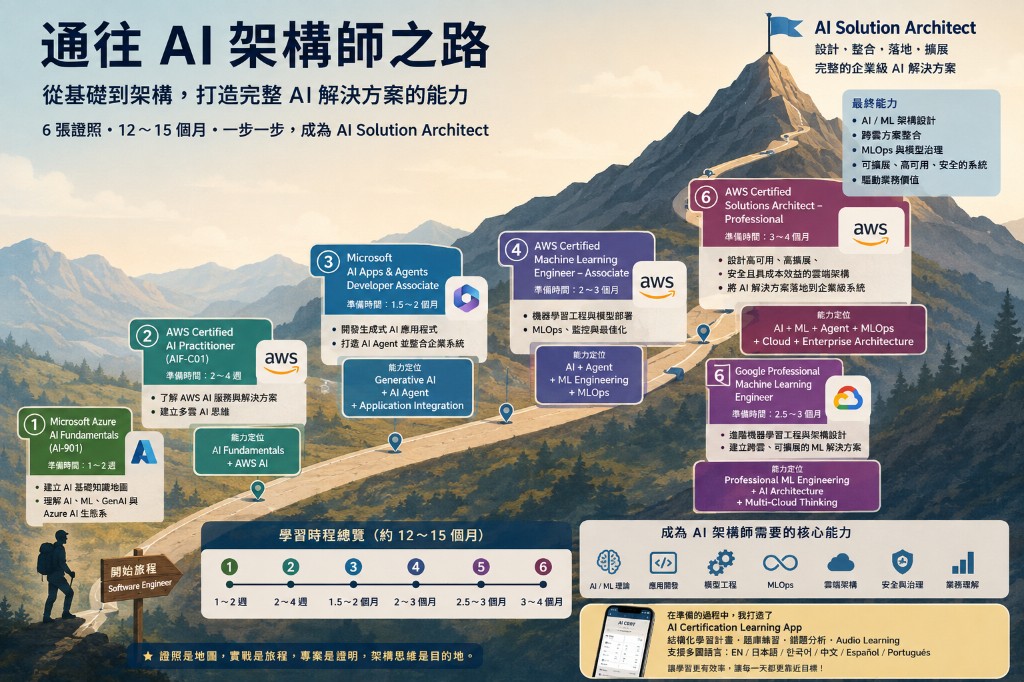
So I set myself a new direction: become an AI Solution Architect. Six certifications, about 12–15 months, deliberately starting easy and moving toward application development, ML engineering and cloud architecture.
The six certifications I planned
| # | Certification | Prep time | Difficulty | Depth | Market value |
|---|---|---|---|---|---|
| 1 | Microsoft Azure AI Fundamentals (AI-901) | 1–2 weeks | ★★☆☆☆ | ★★☆☆☆ | ★★☆☆☆ |
| 2 | AWS Certified AI Practitioner (AIF-C01) | 2–4 weeks | ★★☆☆☆ | ★★★☆☆ | ★★★☆☆ |
| 3 | Microsoft AI Apps & Agents Developer Associate | 1.5–2 months | ★★★☆☆ | ★★★★☆ | ★★★★☆ |
| 4 | AWS Machine Learning Engineer – Associate | 2–3 months | ★★★★☆ | ★★★★☆ | ★★★★☆ |
| 5 | Google Professional Machine Learning Engineer | 2.5–3 months | ★★★★★ | ★★★★★ | ★★★★★ |
| 6 | AWS Solutions Architect – Professional | 3–4 months | ★★★★★ | ★★★★★ | ★★★★★ |
These stars are not official ratings. “Difficulty” is my estimate of what it takes to pass, “depth” is the technical depth the exam covers, and “market value” is how much the certification stands out on an AI / cloud résumé.
Why this order
1. AI-901: lay the foundation. When you already use LLMs and APIs daily it is easy to assume you understand everything, but having used something and understanding it systematically are different. The first one is intentionally easy: it reorganizes scattered AI knowledge.
2. AIF-C01: see the same thing on a second cloud. AWS uses different product names and mechanics for the same underlying ideas. If you only know one vendor, your first reaction to a problem is “which product do I use?”; an architect should first ask what architecture the problem actually needs.
3. Microsoft AI Apps & Agents Developer: start building real systems. Calling an LLM API is easy; putting AI into a system is not. How does it reach company data, how does it call existing APIs, what may an agent decide alone, what needs human confirmation, how are permissions handled, and what happens when the answer is wrong?
4. AWS Machine Learning Engineer: add ML engineering and MLOps. Companies still have plenty of classic machine learning needs, and in production the question is rarely just model accuracy — it is deployment, data pipelines, version updates, monitoring and cost.
5. Google Professional ML Engineer: separate products from architecture. After three clouds, the point is not knowing three consoles but seeing that three differently named services solve the same class of problem. Engineers ask how; architects also ask why, what the alternatives are, and what they cost.
6. AWS Solutions Architect – Professional: back to architecture itself. The last one is deliberately not an AI exam, because an AI architect is an architect first. Adopting AI does not remove database, network, security, IAM (Identity and Access Management), scalability, disaster recovery or cost concerns — it makes them harder.
While preparing for AIF-C01, I built this app
This was not part of the plan. While studying for AIF-C01 I went through a lot of material and question banks, and something was always missing. I did not want to just grind questions: when I got one wrong I wanted to know why, and some correct answers were only lucky guesses.
The other problem was time. Hours at a desk are limited, but walking, commuting and short breaks add up. Since I write software for a living, I built the version I wanted to use.
The first release starts with AIF-C01, paced over 14 days so you know what to study today instead of opening a bank of hundreds of questions. Audio learning is built in, so you can review while walking or commuting. It ships in English, 日本語, 한국어, Chinese, Español and Português (Brasil).
Total time: 12–15 months
| Certification | Prep time | Cumulative |
|---|---|---|
| Microsoft AI-901 | 1–2 weeks | month 1 |
| AWS AIF-C01 | 2–4 weeks | months 1–2 |
| Microsoft AI Apps & Agents Developer | 1.5–2 months | months 2–4 |
| AWS Machine Learning Engineer | 2–3 months | months 4–7 |
| Google Professional ML Engineer | 2.5–3 months | months 7–10 |
| AWS Solutions Architect Professional | 3–4 months | months 10–15 |
Work, development and life continue in parallel. 12–15 months is a goal, not a deadline. If one stage needs more time I would rather build something real than memorize a question bank to hit a date.
Certifications are not the goal
I take exams because they define a scope to study and give each stage a clear target. But six certificates do not make someone an AI architect — if a year from now I only have six badges on LinkedIn and have never built an AI system, the year did not do what I wanted.
So I set one more rule: every stage must leave behind something I can actually show. An app, an agent, a RAG system, an ML pipeline, or a complete architecture design. Certifications tell me what to learn; building tells me whether I can.
Why an AI architect
I do not want to become someone who only researches models. What interests me is connecting AI to existing software, making agents cooperate with current systems, handling data, deploying and scaling, controlling cost, keeping it secure — and finally assembling something people can actually use and a company is willing to run in production.
Software Engineering
+ AI / ML
+ Generative AI / Agent
+ MLOps
+ Cloud Architecture
= AI Solution Architect
Twelve to fifteen months, six certifications, building and learning along the way — and writing the whole thing down.